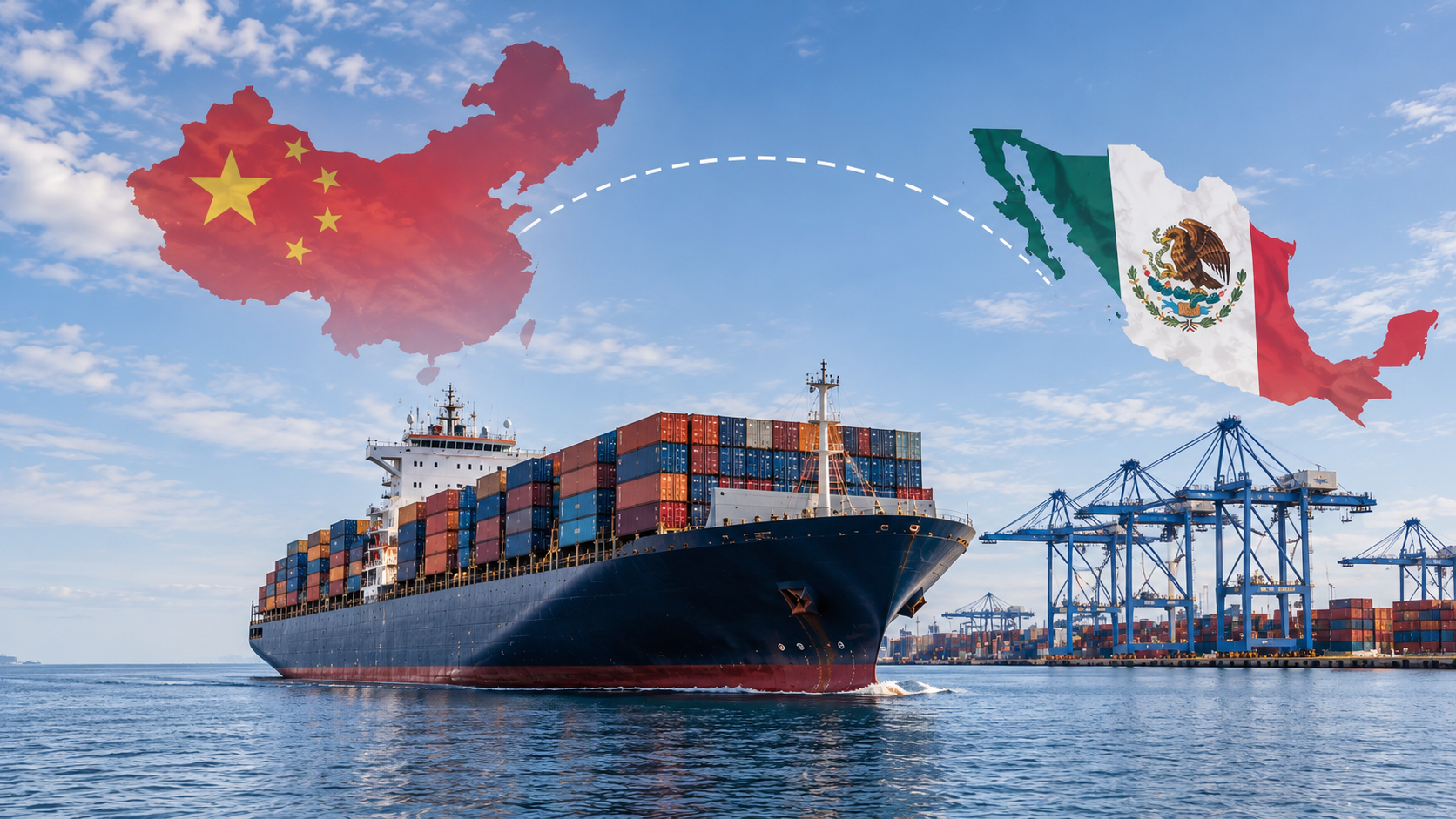
Freights to Mexico: when the container costs triple, the margin is decided before booking
Moving a container from China to Mexico cost about $2,000 before February. Today it hovers around $6,000. We explain why freights have risen so much, how long it may last, and what you can do now to protect your margin if you work with Mexico.
Maritime freights between China and Mexico have experienced an unprecedented increase: from about $2,000 USD at the end of 2025 to around $6,000 USD today, according to the Mexican Association of Shipping Agents (Amanac). This jump directly affects importers, exporters and any company that purchases in Asia for Mexico. Below we analyse the causes, the expected duration and the actions you can take this week to protect your margins.
What has happened to the freights
The price surge began after the United States‑Iran conflict, which started on February 28 2026, limiting traffic through the Strait of Hormuz. Routes lengthened, fuel became more expensive and, as a result, rates tripled.
“Rates have tripled and we do not see a quick solution,” says Roberto Meillón, president of Amanac.
The Drewry World Container Index, which tracks the price of a 40‑foot container, shows a similar rise on the Shanghai–Los Angeles route (from $2,438 USD to $7,514 USD in a year). Although it is not the direct route to Mexico, it acts as a market thermometer for the trans‑Pacific market, on which the ports of Manzanillo and Lázaro Cárdenas depend.
Why it is rising so much
Three factors combine and reinforce each other:
- Fuel: Marine VLSFO fuel surpassed $1,000 USD/ton in Singapore, raising the bunkering bill of a 3,000‑t vessel to about $3 million USD, compared with $1.56 million before the conflict. UNCTAD indicates that fuel price was 72 % above the average of the previous six months.
- Available capacity: Avoiding the Red Sea has reduced the effective fleet capacity by 12 % and the practice of sailing slower to save fuel has consumed another 2 % of usable capacity.
- Surcharges: Shipping lines apply emergency fuel surcharges (BAF) even on routes that do not cross the Middle East, passing the cost on to customers.
How long will it last?
Forecasts diverge:
- Amanac estimates that price pressure will remain between six and eight months.
- Xeneta believes the peak on the China‑US route has already passed and foresees a gradual decline, without an immediate collapse.
- External factors, such as the recent capture of 24 vessels in the Hormuz area, add uncertainty to negotiations between carriers and shippers.
In practice, the recommendation is to plan with high rates as the base scenario and treat any reduction as a benefit, not as an expectation.
Who ends up paying
According to the Secretariat of Industry and Commerce (SICT), 33 % of Mexican merchandise is transported by ship. The extra cost falls first on the importer; if the margin does not absorb the increase, the final price is passed to the consumer, generating inflationary pressure.
Practical example: a $4,000 USD increase in the freight of a container with 10,000 units represents an additional cost of $0.40 USD per unit. On a product costing $3 USD, that is more than 13 % of the price; on one costing $50 USD, less than 1 %. Each company must assess the impact according to its own pricing structure.
Volume continues to grow: Manzanillo recorded 3,154,778 TEU between January and September 2026, 9.5 % more than the previous year, making early booking even more crucial.
What you can do now
- Recalculate the cost delivered with the current rate. Using old data creates illusory margins.
- Request quotes with short validity and break down the surcharges. Identify the base freight portion and the part attributable to BAF or emergency surcharges.
- Review the Incoterms and contracts. Include clauses that define who assumes freight variation between order and shipment.
- Book in advance. Check the blank sailings (canceled departures) before committing dates with your client.
- Compare ports and routes. Manzanillo and Lázaro Cárdenas can offer different transit times and prices; also evaluate the new services between Asia and the west coast of Mexico.
- Consider air transport for high‑value or urgent goods. The price gap between sea and air has narrowed.
- Communicate proactively with your client. An early notice about possible surcharges is perceived better than a surprise on the invoice.
In summary
The tripling of freights to Mexico is not an isolated phenomenon, but the result of a combination of geopolitical conflict, fuel price increase and capacity reduction. Although the exact duration is uncertain, the trend suggests that prices will remain high for several months. The key to protecting your margins lies in planning based on current data, reviewing contracts and early communication with customers and suppliers.
At a3 Logistic we are ready to offer you route comparisons, transit times and surcharges tailored to your shipments to Mexico. Write to us and make decisions with numbers, not surprises.
Need help with your logistics?
Our team is ready to help you find the best solution for your business.
Let's talk