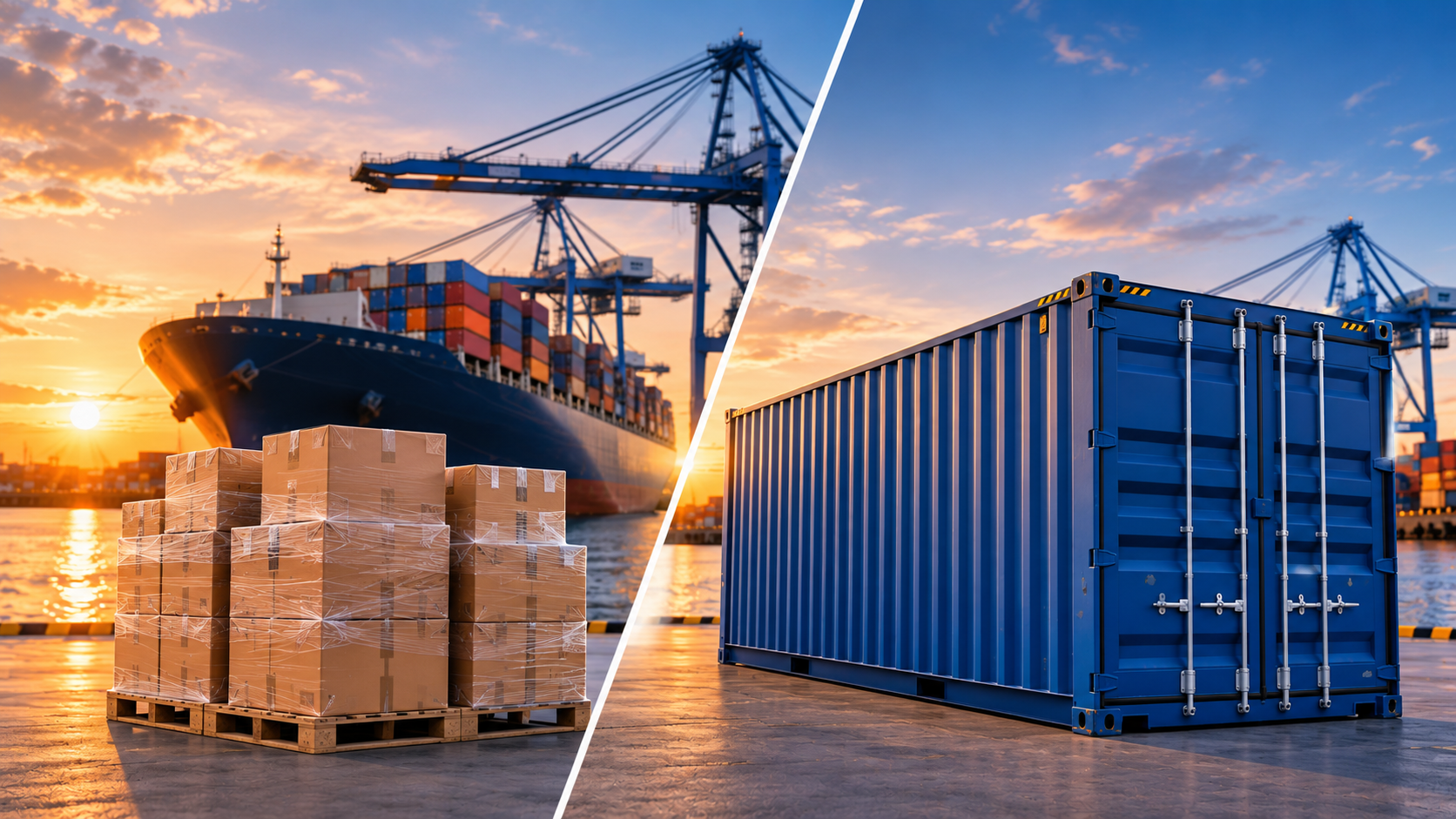
Maritime LCL vs. Full Container Load (FCL): Which to Choose?
Discover the differences between maritime LCL and full container load (FCL), their costs, transit times and advantages. We analyze when each option makes sense and why, from 14-15 m³ onward, hiring a full container can be more profitable, faster and safer for your goods.
When planning an import or export operation by sea, one of the first questions that arises in any purchasing or logistics department is how to book vessel space: is LCL consolidation more cost‑effective or a full container (FCL)? The answer depends on volume, urgency and the sensitivity of the cargo.
What is maritime LCL?
The LCL shipment (Less than Container Load) consists of sharing a container’s space with goods from other importers or exporters traveling on the same route.
- When it is used: small or medium shipments, frequent replenishments, first purchases from new suppliers.
- How it works: the freight forwarder consolidates several customers’ cargo in an origin warehouse, fills the container and, upon arrival at the destination port, empties it (de‑consolidates) to deliver each parcel to its recipient.
- Billing: you pay for the actual space the cargo occupies, usually calculated by tonnage or cubic metre (the higher of the two applies).
What is a full container load (FCL)?
The FCL shipment (Full Container Load) involves exclusively hiring a container for your goods, regardless of whether you fill it 100 % or 70 %.
- Standard formats: 20‑foot container (≈ 28‑30 m³ usable) and 40‑foot container (≈ 58‑60 m³, up to 68 m³ in High Cube version).
- When it is used: large volumes, recurring high‑turnover orders, fragile loads or products that require maximum security and speed.
- How it works: the container is loaded directly at the supplier’s premises, sealed and not opened again until it reaches your warehouse (except for customs inspection).
Quick comparison LCL vs. FCL
- Recommended volume: LCL from 1 m³ up to 13‑15 m³; FCL from 14‑15 m³.
- Cost: LCL proportional to volume/weight; FCL fixed rate per container.
- Transit time: LCL slower (+4 to 7 days for consolidation and de‑consolidation); FCL faster (direct door‑to‑door).
- Handling and risk: LCL more handling at origin and destination; FCL minimal handling, sealed container.
- Customs procedure: LCL can be delayed if another customer does not load on time; FCL cleared independently and exclusively.
The tipping point lies between 13 and 15 m³: beyond that range, the total cost of an LCL shipment usually matches or exceeds the fixed price of an FCL container.
The 14‑15 m³ rule
A 20‑foot container has a theoretical capacity of about 33 m³, but only around 28 m³ are truly usable depending on packaging. It is not necessary to fill it to the maximum to be profitable. When the cargo exceeds 14‑15 m³, the sum of the LCL freight plus destination surcharges tends to be more expensive than hiring a full container.
Practical example: importing 16 m³ from Asia to Barcelona or Valencia is usually cheaper in a 20‑foot container, even if it remains half empty, and it also guarantees a faster and safer arrival.
Factors beyond price
- Fragility and type of packaging: in LCL the goods share space with third parties and undergo more loading/unloading cycles. FCL reduces the risk of damage for delicate or high‑value products.
- Tight delivery deadlines: consolidation requires waiting for the load to be completed and for de‑consolidation at destination. FCL offers greater predictability for commercial campaigns or critical deliveries.
- Control of delays and charges (Demurrage & Detention): with FCL you have free days in port to clear and return the empty container; proper documentation planning avoids penalties.
Frequently asked questions
Can I ship less than 1 m³ by sea?
Yes. In LCL there is a minimum billable amount (usually 1 m³ or 1 tonne). If the shipment weighs less than 150‑200 kg and occupies little volume, it is worth comparing the LCL cost with air freight, as the price difference can be small compared with the time savings.
What happens if another importer in the same LCL container has a customs issue?
Customs clearances are individual, but the container must be emptied before the loads can be released. A documentation incident with another client can slightly delay the availability of your cargo. A proactive freight forwarder speeds up release after de‑consolidation.
How do I calculate the cubic metres of my cargo?
Multiply length × width × height (in metres) of each package or pallet and add the results. For example, a standard European pallet (1.20 m × 0.80 m) with a height of 1.50 m occupies 1.44 m³.
Need help with your logistics?
Our team is ready to help you find the best solution for your business.
Let's talk