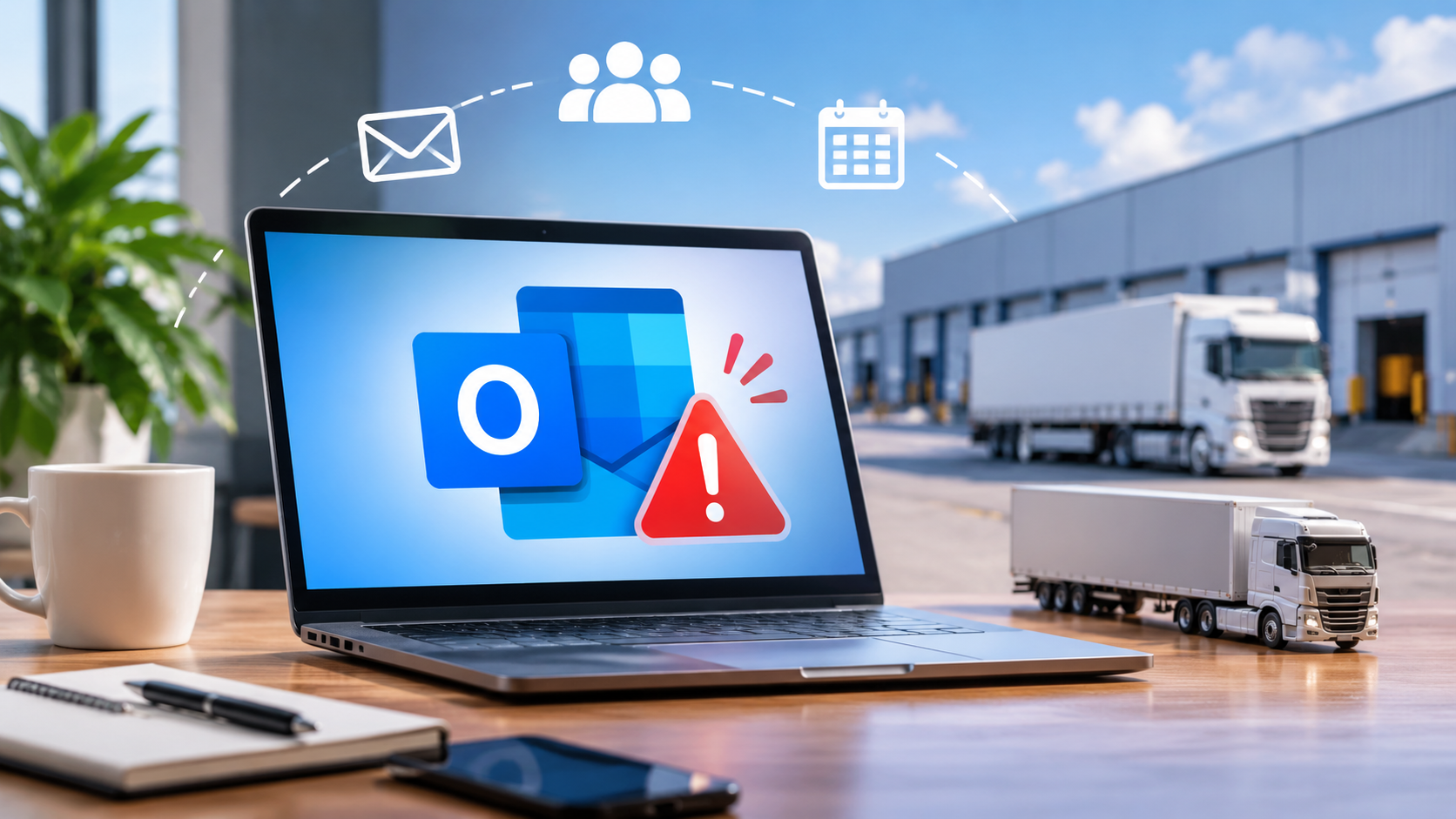
Outlook outage tests logistics: when an undelivered email can halt an operation
The recent Microsoft 365 and Outlook outage has highlighted the importance of communication in the logistics sector. A technological incident can affect coordination with customers, suppliers and carriers, causing delays in confirmations, procedures and operations. This situation reminds us that logistics is not only about moving goods, but also ensuring that information arrives on time. Because when communication fails, the whole chain can feel it.
A global incident in Microsoft 365 is affecting services such as Outlook and Teams, causing email access problems, message delivery delays and connection difficulties for users around the world. Microsoft has confirmed that the incident is related to Exchange Online and that certain infrastructures have experienced high load, while its teams work to restore normalcy.
At first glance, it may seem like just another technological problem. An email that takes long to arrive, an inbox that does not load or a Teams meeting that does not work.
But in sectors like logistics, an email that does not arrive can mean much more.
It can mean a truck waiting for confirmation, a customer waiting for a delivery date, a carrier without instructions, documentation that is not received on time or an operation pending a response that we simply cannot send.
Impact of the Outlook outage on the logistics chain
An interruption of email service affects several operational links:
- Pickup confirmations: carriers may be left waiting for final authorization.
- Document sending (invoices, delivery notes, incoterms): the lack of these documents delays the release of goods.
- Incident management: communication of breakdowns or diversions becomes slower, increasing response time.
- Route coordination: Transport Management System (TMS) planners lose the ability to update drivers in real time.
- Customer updates: information on shipment status does not arrive on time, generating uncertainty.
The importance of communication with customers and suppliers
One of the aspects that can be most affected is the relationship with customers. In a sector where quick response and up‑to‑date information are essential, not being able to answer an inquiry or confirm the status of an operation can generate uncertainty.
Customers need to know when a pickup will take place, the status of their shipment or whether any unforeseen event has arisen during transport. When the usual communication channels stop working, providing that information becomes an additional challenge.
The same happens with suppliers, collaborators and carriers, whose coordination is essential for operations to run smoothly. Therefore, having alternative contact channels can make the difference in moments like this.
Lessons learned and preventive measures
To mitigate the risk of an Outlook outage (or any other tool), logistics companies can adopt the following protocols:
- Backup channels: establish telephone lines, instant messaging (WhatsApp Business, Signal) and alternative collaboration platforms (Slack, Microsoft Teams with fallback to chat).
- Emergency procedures: create step‑by‑step guides for re‑sending critical documentation via Electronic Data Interchange (EDI) or internal systems.
- Constant contact updates: maintain a centralized database with phone numbers and alternative emails of customers, suppliers and carriers.
- Staff training: train teams to quickly recognise the incident and activate alternative communication protocols.
- Proactive monitoring: use service monitoring tools (status pages, SMS alerts) to detect failures before they impact operations.
“A logistics chain is only as strong as the speed and reliability of its communication.” – Operations management expert
How to prepare for a technological incident?
Logistics companies must be ready to face situations that may affect their communications. Keeping contact phone numbers of customers and suppliers up to date, having alternative ways to transmit urgent information and establishing internal action protocols are some measures that can help reduce the impact of these incidents.
It is also important that teams know how to act when usual tools are unavailable. Quickness in seeking alternatives and coordination between departments allow activity to continue as much as possible and prevent a technological problem from becoming a larger operational difficulty.
In the end, adaptability is a fundamental part of any logistics operation.
Today it is Outlook, tomorrow it could be any other tool
The Microsoft 365 incident gives us an important reflection: logistics is not only about moving goods from point A to point B. It is also about moving information, coordinating people and ensuring each operation runs as efficiently as possible.
A truck may be ready to depart, a warehouse may have goods prepared and a customer may be waiting for their order. But if the information does not arrive, everything can become complicated.
While we wait for Outlook to return to normal, we continue working to keep contact with our customers through the available channels and minimise any inconvenience this situation may cause.
And if in recent days you have tried to contact us and still have not received a response, rest assured: we are not practising the famous corporate ghosting, nor have we taken an unexpected vacation. Simply, Outlook has decided to put us to the test.
Because in logistics we are used to solving unforeseen events, but, if possible, we prefer them on the road rather than in our inbox.
Need help with your logistics?
Our team is ready to help you find the best solution for your business.
Let's talk