International Air Logistics from Barcelona (El Prat): When It Pays Off Compared to Sea
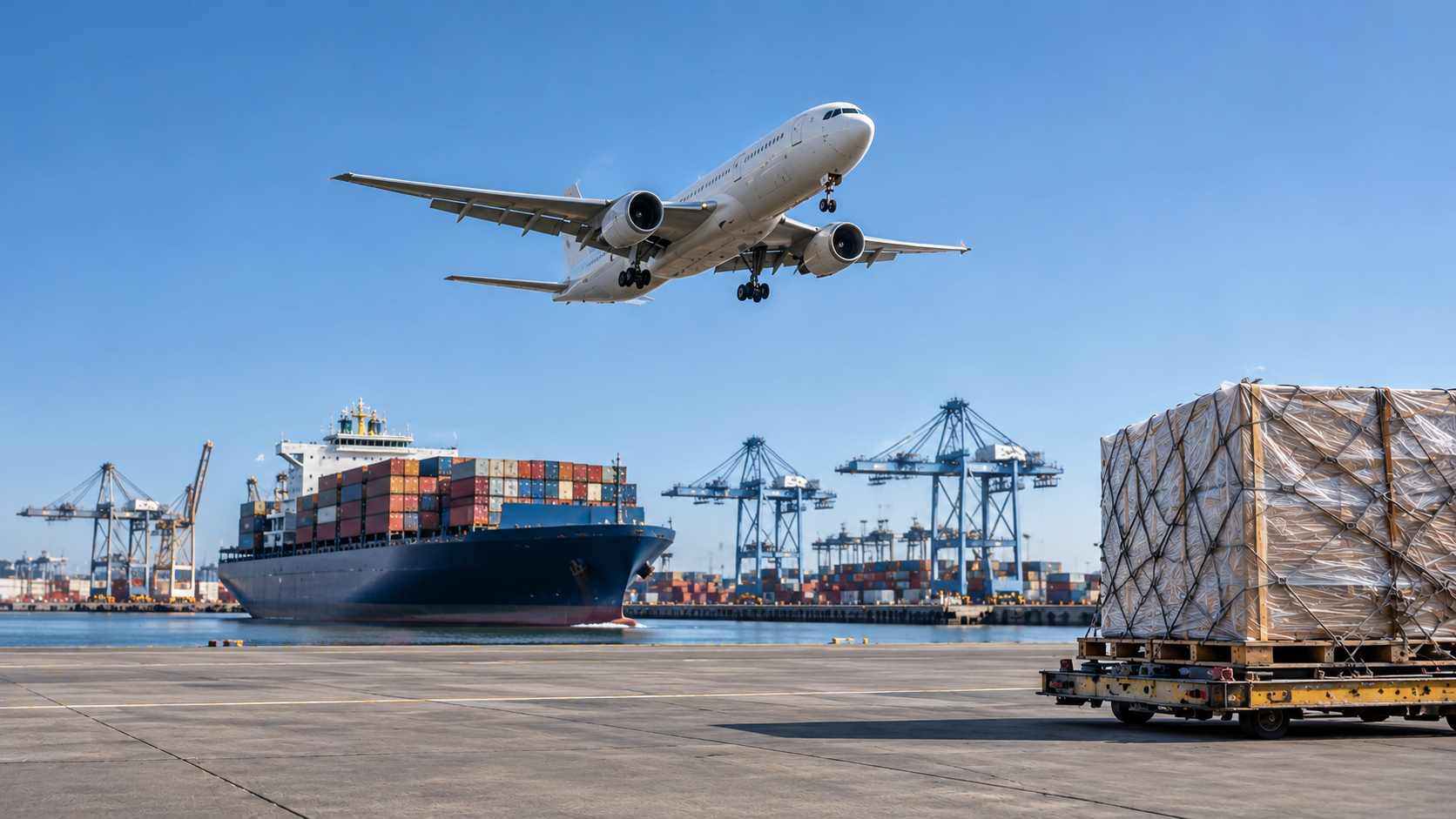
What advantages does international air transport from Barcelona-El Prat have over sea transport, when it pays off and how to decide between one and the other. More and more companies ask us the same thing: should I ship this cargo by plane or by ship? The doubt is logical. Both modes reach the same destination, but they do so in very different ways in terms of timelines, cost, risk and flexibility. And from Barcelona, with El Prat airport and the port only a few kilometres from each other, you are lucky enough to be able to choose.
Barcelona‑El Prat airport has become one of the main entry and exit points for cargo in Southern Europe. Its own cargo terminal, proximity to the Free Zone and the logistics parks of Baix Llobregat, and its direct connections with Asia, America and the Middle East make international air logistics an increasingly attractive option for companies that import or export from Catalonia.
Why air logistics from El Prat is strategic
Being so close to the airport, companies significantly reduce road kilometres both before the cargo takes off and after it lands. In a sector where every hour counts, that reduction translates into lower operating costs and greater speed in the supply chain.
Moreover, delivery times demanded by customers have shortened and inventories are tighter; nobody wants goods to sit in a warehouse waiting to be dispatched. In this context, the plane positions itself as the ideal solution.
Advantages of air transport
- Speed. It is the main reason. An air shipment can reach its destination in one or a few days, whereas a sea container from Asia can take four to six weeks to be available, counting navigation, stops and port procedures. If your client needs the order now, there is little debate.
- Reliability of schedules. Flights have fixed timetables and high frequency. Sea transport depends more on port congestion, weather and intermediate stops. When there are delays, the plane suffers far less.
- Less handling and lower risk. The goods pass through fewer hands and spend less time in transit, reducing the risk of damage and loss. For delicate, high‑value or shock‑, vibration‑ or humidity‑sensitive products, this is a key point.
- Less immobilised stock. If you bring the goods in days instead of weeks, you can work with smaller inventories. That money not tied up in product becomes liquidity for other things.
- Simpler packaging. Because the journey is shorter and handling is reduced, packaging can often be lighter, which also saves weight and volume.
- Quick response to unforeseen events. A production failure, a stockout, an urgent order from an important client. Air allows you to react when sea no longer arrives on time.
When sea transport remains the best option
- Bulky or heavy cargo: the cost per kilo by air is considerably higher and the difference grows with weight.
- Low‑value‑per‑kilo product: if the value of the goods is low relative to their weight, air freight can erode the margin.
- Long‑term planning: when the need for the goods is known months in advance, the ship is much more economical.
- Large regular volumes: for full containers on a recurring basis, sea is hard to beat in cost.
The ship wins on price, the plane wins on time. The question is how much time is worth to your business.
How to decide: four key questions
- How urgent is the shipment? If you can wait a month, sea probably pays off; if not, air.
- How much does it weigh and how much space does it occupy? Air freight is billed by actual weight or volumetric weight, whichever is greater. A light but bulky shipment can become costly.
- What is the value of the goods? The higher the value per kilo, the easier it is to justify the cost of the plane.
- What does it cost you to have the product idle? A lost sale or a customer churn usually outweighs the freight price difference between the two modes.
In many cases the optimal solution combines both modes: the ship for the bulk of the order and the plane to cover the first weeks, launch products or handle emergencies.
Goods most frequently shipped by air
- Pharmaceutical and medical products
- Electronics and technical components
- Seasonal fashion and textiles
- Spare parts and industrial replacements
- Perishables (fresh products and short‑shelf‑life food)
- Samples, prototypes and product launches
Critical aspects before shipping by air
- Customs documentation complete and correct at origin and destination; any error can stop the cargo.
- Incoterms well defined: they establish who assumes each segment, the costs and the risks.
- Restricted or hazardous goods (batteries, liquids, chemicals) require compliance with specific regulations.
- Cargo insurance: the value is often high, so it is advisable to insure it.
- Pickup and delivery: the flight is only part of the journey; road transport to and from the airport also influences timelines and costs.
Working with a logistics operator in Barcelona
Managing an international air shipment on your own is possible, but it becomes complicated when customs, space bookings, route changes or incidents come into play. A logistics operator with a presence in El Prat solves all that and, above all, helps you decide which transport mode suits each specific case, without pushing you toward a default option.
At a3 Logistic we handle sea, air and land transport, so we have no preference for any mode. What we aim for is that your goods arrive safely, on time and at the best possible cost for your needs.
If you are evaluating a shipment and are not sure whether air or sea is more cost‑effective, tell us what you move, where to and with what deadline. We will prepare a comparison of the two options so you can decide with numbers in front of you.
Do you want a quote for international air transport from Barcelona? Write to us and we will reply with a tailored proposal.
Need help with your logistics?
Our team is ready to help you find the best solution for your business.
Let's talk