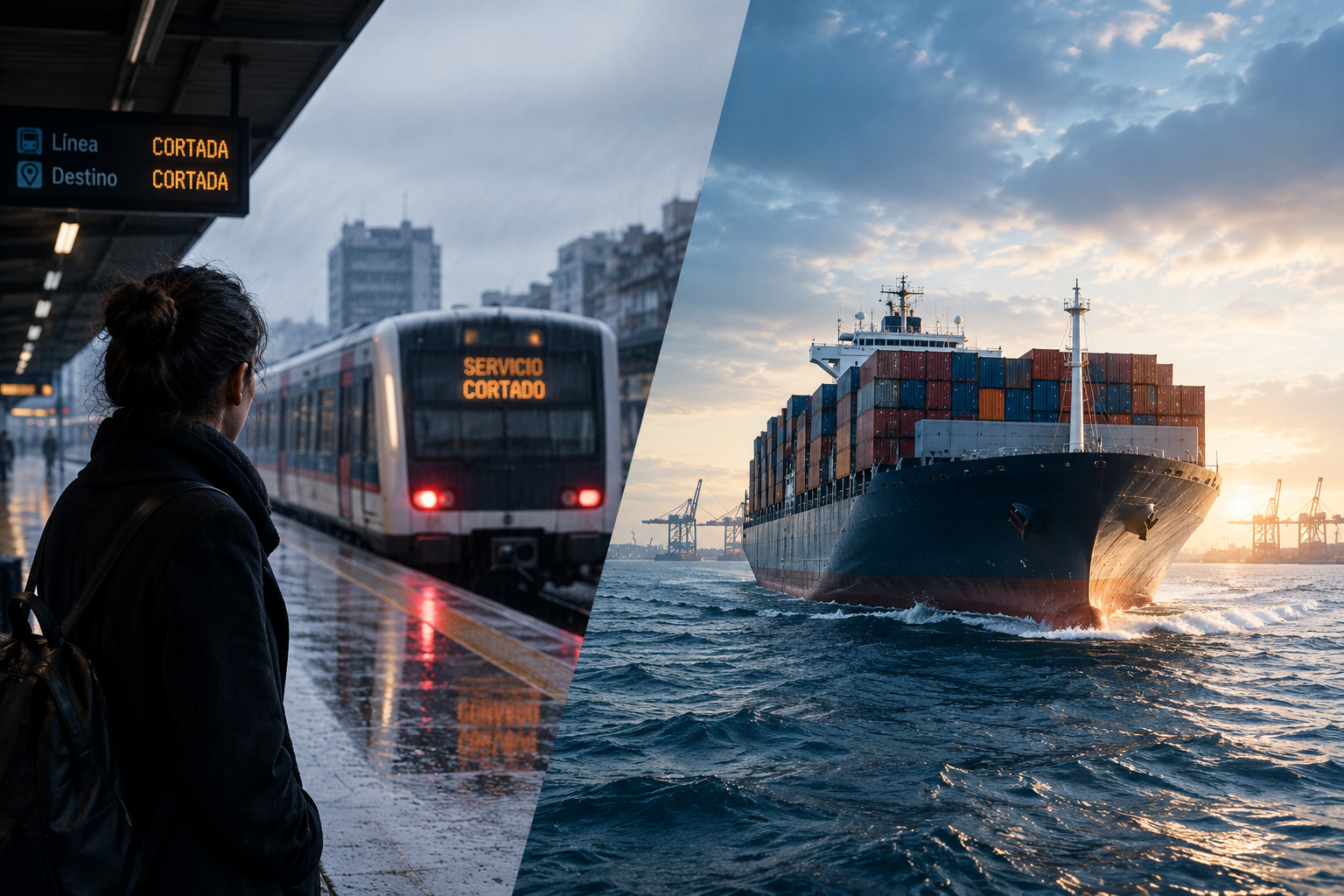
When Your Train Doesn't Arrive, What If It's a Ship That Doesn't Arrive?
A delay in transport can become a much bigger problem when we talk about goods and international supply chains. Discover how planning, alternative routes and rapid communication allow you to anticipate incidents and minimise their impact on maritime, air and land transport.
When Your Train Doesn't Arrive, What If It's a Ship That Doesn't Arrive?
A rainy Monday, the train line is closed and half the city is forced to look for alternative routes to get to work. You arrive late, with wet shoes and morale at rock bottom. That personal setback is annoying, but it passes quickly.
Now imagine that the “traveller” suffering the delay is not you, but a container ship carrying thousands of units: parts for a factory, medicines, seasonal clothing and food. Each container carries a customer, a deadline and, often, a supply chain that depends on its timely arrival. A logistical delay, unlike a personal one, entails real costs and production losses.
Lessons from a Chaotic Day
When transport fails, the instinctive reaction is to improvise: find another route, another mode, ask to be picked up. In logistics that improvisation is not viable; structured planning is required.
- Anticipate before it happens. No one leaves home without checking the weather if they know problems may arise. In international transport the same is done, but on a larger scale: weather forecasts, port congestion, strikes and border closures are monitored. Many problems are solved before they occur.
- Have a plan B (and a plan C). If the train fails, you take the bus; if a port is saturated, you look for another. In the supply chain multimodal transport (maritime, air and land) is used to keep the flow fluid.
- Communicate quickly and clearly. Notifying a delay in advance allows the client to make decisions. An early notice can be managed; a surprise creates a crisis.
- Accept what cannot be controlled. We cannot stop a storm or avoid a mechanical breakdown, but we can define what to do when it occurs and minimise its impact.
The Scale Difference
Your daily commute lasts minutes; a ship travels weeks, crossing several countries, ports and customs. Each point is a possible incident: customs inspections, incoterm regulations, draft limitations or terminal congestion. That is why experience is key. At a3 Logistic we have faced storms, collapsed ports and last‑minute changes, learning to anticipate and solve each challenge.
“In the logistics chain, every hour of delay translates into real costs for the client and a loss of competitiveness for the exporter.”
So Next Time the Train Stops
Think for a moment about everything that moves each day so you have what you have at home, in the store or at work. Most of the time it goes unnoticed, and that is a good sign: it means someone has done their job well before the problem appeared. If your company imports or exports and you want to know how to prevent an unforeseen event from becoming a problem, at a3 Logistic we will be happy to study your case. We are in El Prat de Llobregat, next to the port and Barcelona airport.
Need help with your logistics?
Our team is ready to help you find the best solution for your business.
Let's talk